How to read a spec sheet
Every red light panel quotes a big number. Ask how it was measured.
Four questions that separate a lab measurement from a marketing number, worked through reports you can open yourself.
You have been comparing red light panels for a while now. Two of them quote intensity figures that are nothing like each other, and both look like the same slab of red LEDs behind the same sheet of plastic. One costs a few hundred dollars. One costs well over a thousand. Nothing on either page tells you why.
This is the moment most people stall. Here is a real one, posted this month on a product page:
★★★★★
“I’ve been researching red light therapy panels for about 3 years and finally decided to go with the PlatinumLED NANO.”
Stephannie B., August 10, 2026
Three years. Not because the information is hidden, but because the numbers on offer are not comparable. They are answers to different questions, printed as if they were answers to the same one.
Nobody in this category has to lie to produce that confusion. There are at least four independent choices to make before you can measure the output of a light panel, and between them they move the answer by more than a factor of two on the exact same hardware. If a brand quotes one number and never says which instrument, which distance, which wavelengths and which part of the beam, the number is unfalsifiable. It is not a specification. It is a mood.
So here are the four questions, in the order that matters, each one worked through on hardware whose full test reports are public. By the end you will be able to read any panel’s claim in about thirty seconds, and you will know exactly which document to ask for when there isn’t one.
The four questions, in order of how much they move the number
- Measured with what? A handheld meter and an accredited lab spectrometer can disagree by more than a factor of two.
- Measured how far away? An intensity figure with no distance attached is a speed with no unit.
- Measured across which wavelengths? The full band a meter sees is almost twice the red band alone.
- Measured at one point, or averaged? The center of the panel is, by construction, its best square inch.
Question one: measured with what instrument?
Start with the tool, because it is worth more than every other variable combined.
The first generation of red light brands measured intensity with a handheld solar power meter. You hold it at the center of the panel, at some distance, and read a number. It is cheap, fast and repeatable, and for about a decade it was simply how the category did it. PlatinumLED, which has been in this market since 2010, says so plainly on its own explainer page:
A single center point test is performed using a handheld solar power meter. These were the first tests that were performed and used in the industry by PlatinumLED and they became the industry standard before proper testing methods and equipment became available. PlatinumLED, Joules vs. mW/cm²: How To Read These Charts
The second method is what accredited photometry labs do. A calibrated spectral irradiance meter takes a reading at every one inch interval across a defined target area, and the readings are averaged. Same page, same brand:
A professional, calibrated spectrometer is used and a small sample area of the light is used with a single point measured at each one inch interval within the sample area. The average of all of these readings is calculated and a single number in terms of mW/cm2 is given. This method is now the new standard for intensity testing. PlatinumLED, same page
Two methods, both honest, both still in circulation. Now watch what happens when you run both on one panel.
PlatinumLED publishes an intensity chart for the BIOMAX PRO ULTRA on its product page. At six inches it reads 292 mW/cm². The chart carries its own method label in small type along the bottom, which is more than most of this category bothers to print:
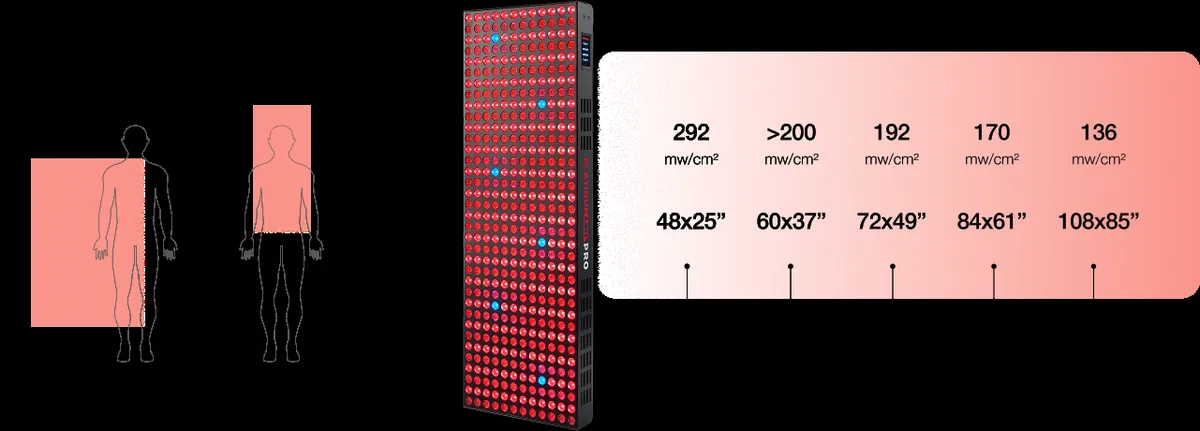
From the same product page, PlatinumLED also links the raw third party report on the same panel. It was run by LightLab International Allentown, an NVLAP accredited photometry lab, using Gigahertz-Optik BTS2048 spectral irradiance meters in a goniometer room with stray light reduction, to the applicable sections of LM-91-22, LM-79-24 and LM-58-20. Forty nine points, one inch apart, across a six by six inch square. That is the grid at the top of this page.
Here is what the two documents say about the same panel at the same distance.
Solar power meter
292 mW/cm²
One reading, at the center of the panel, six inches away. Published on the product page.
Accredited lab spectrometer
121.12 mW/cm²
Center point, six inches away, 350 to 1700 nm. Report LLIA002684-006. Averaged across the target area it falls to 102.62.
Neither figure is wrong. They were taken with different instruments under different definitions, and the brand publishes both plus the underlying report, which is the only reason you can see the gap at all. What should stop you cold is the size of it. Better than a factor of two, on identical hardware, from a company that is documenting itself more carefully than most of its competitors.
Now imagine the panel that quotes a single number and links nothing.
The thirty second version
When a panel advertises an intensity figure, there are exactly two useful follow up questions. Which instrument? And can I see the report? If the answer to the second one is a screenshot of a handheld meter, you have learned something. If it is a PDF with a lab name, a report number and a test date, you have learned considerably more.
A center point reading is not a fraud. It is just a different question, and it always flatters the panel.
Question two: measured how far away?
Light spreads. Every inch you back away, the same photons cover more skin, so the intensity at any one point falls. This is not a product flaw, it is geometry, and it applies identically to the cheapest panel on the market and the most expensive one.
Which means a quoted intensity with no distance attached is meaningless. Not misleading. Meaningless. It is a speed with no unit.
The LightLab report measures the BIOMAX PRO ULTRA at four distances. Three lines, one panel:
From six inches to twenty four, the total reading falls by roughly a third. So if one brand quotes at six inches and another quotes at twelve, the first one wins on paper before either panel is switched on.
What you lose in intensity you gain in coverage, and this is the trade you are actually making. PlatinumLED publishes both halves of it for the ULTRA:
| Distance | Intensity | Area covered |
|---|---|---|
| 6 in | 292 mW/cm² | 48 x 25 in |
| 12 in | over 200 | 60 x 37 in |
| 18 in | 192 | 72 x 49 in |
| 24 in | 170 | 84 x 61 in |
| 36 in | 136 | 108 x 85 in |
At six inches you are treating an area about the size of a laptop bag. At thirty six inches you are treating a doorway. Same panel, same session, completely different job. The distance is not a detail of the specification, it is the specification.
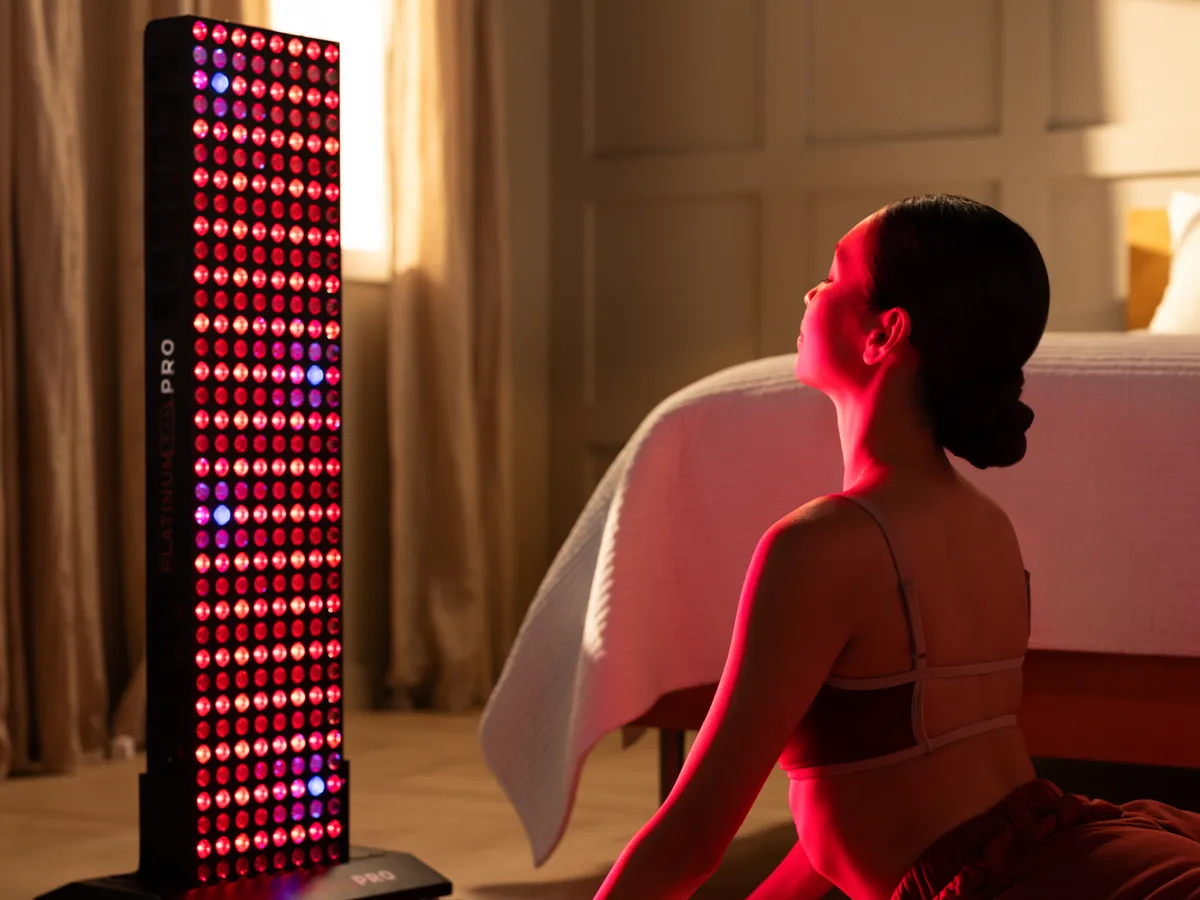
PlatinumLED’s own usage guidance lands at 8 to 14 inches for deep tissue work and 16 to 24 inches for facial skin, with sessions of 10 to 20 minutes per area and 3 to 5 sessions a week. That is a considered answer, and it is worth noticing that it is nowhere near the six inch figure the intensity chart headlines with. The number that sells the panel and the number that describes how you should use it are not the same number.
See the published charts and reportsBIOMAX PRO series on platinumtherapylights.com
03 The wavelengthsQuestion three: measured across which wavelengths?
Here is the one that almost nobody checks, and it is the one that moves the number most.
A spectral irradiance meter set to 350 to 1700 nanometers counts everything it sees in that window. Red light, near infrared, blue, and whatever else the panel emits. The research that people cite when they buy these things is not about that whole window. It is about specific bands, and you can read which ones off the wavelengths the brands themselves choose to build: red around 630 to 660 nm, near infrared around 810 to 850 nm.
The LightLab report is unusual in that it breaks the reading into bands instead of collapsing it to one figure. At six inches, across the same target area, on the same panel, in the same session:
The headline reading is 102.62. The red band alone is 56.22, which is 55 percent of it. The near infrared band is 44.72. A brand that quotes the full band figure and a brand that quotes the red band figure will look almost twice as far apart as they really are, and both will be telling the truth.
This is also why the count of wavelengths on a box is worth so little on its own. Seven wavelengths is a design decision about which absorption peaks to hit, not a performance figure. What tells you something is whether the brand will show you how the output is distributed across those wavelengths, and whether you can change the mix.
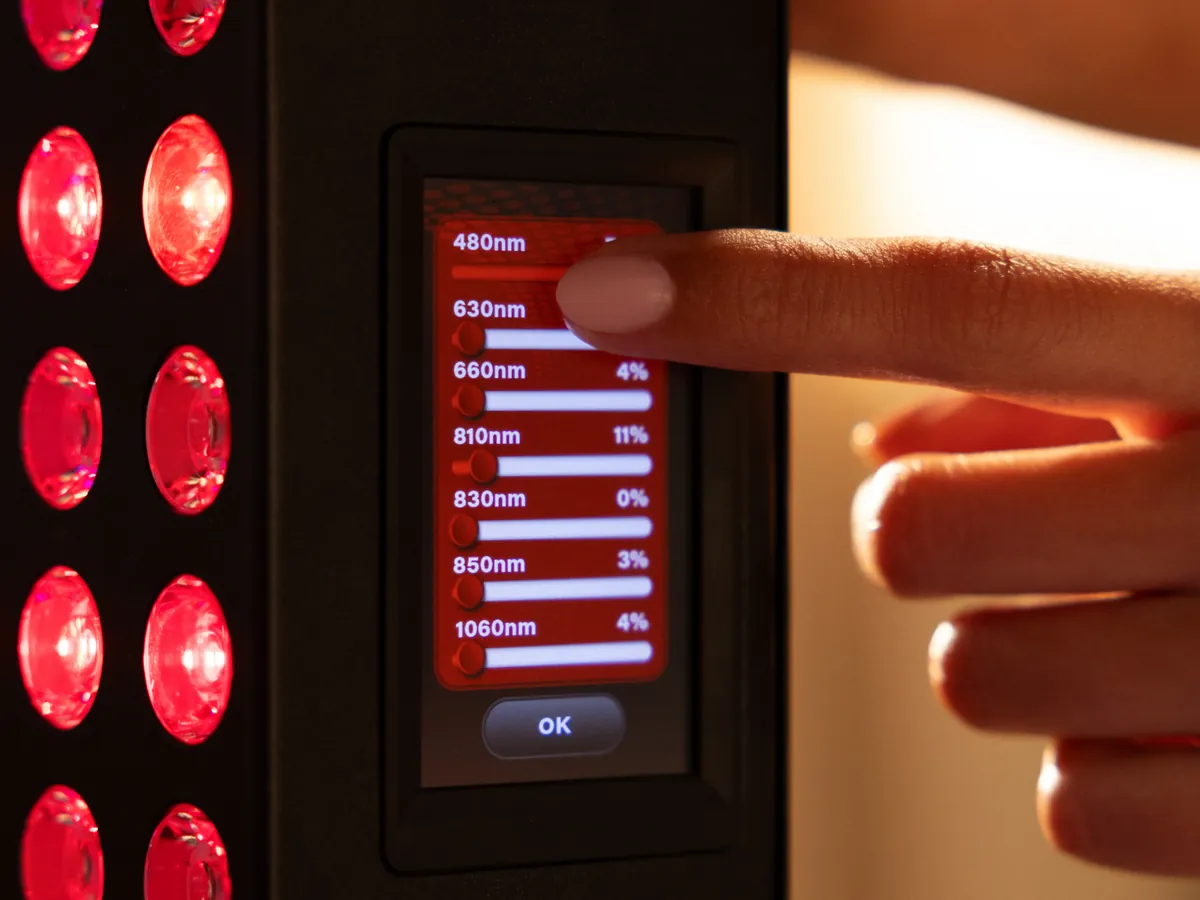
Question four: measured at one point, or across the area you occupy?
A panel is not a spotlight. It is a few hundred separate emitters behind a grid of plastic lenses, and what they produce is a field with hot spots and cool spots. The center point sits, by construction, in the hottest part of it.
Go back to the grid at the top of this page. Report LLIA002684-006 states the three figures that matter for the ULTRA at six inches:
Between the hottest square inch and the coldest, on a six inch square, the report gives a max to min ratio of 1.50. Your shoulder is not in the same beam as your sternum.
The near infrared band is where it gets vivid. At six inches the report gives a max to min ratio of 2.31 for 780 to 1700 nm, and you can see why: the emitters have not blended yet, and the grid still reads like the LED layout. Back off to twelve inches and the ratio drops to 1.22.
Near infrared irradiance, 780 to 1700 nm, same panel, same grid, two distances. Rounded to whole numbers. Report LLIA002684-006.
That is a genuinely useful piece of information and it is not on anybody’s box. Standing a little further back does not just trade intensity for coverage. It trades a patchy field for an even one. If you have ever wondered why a session feels hotter on one patch of skin than another, that is the answer, and the fix is free.
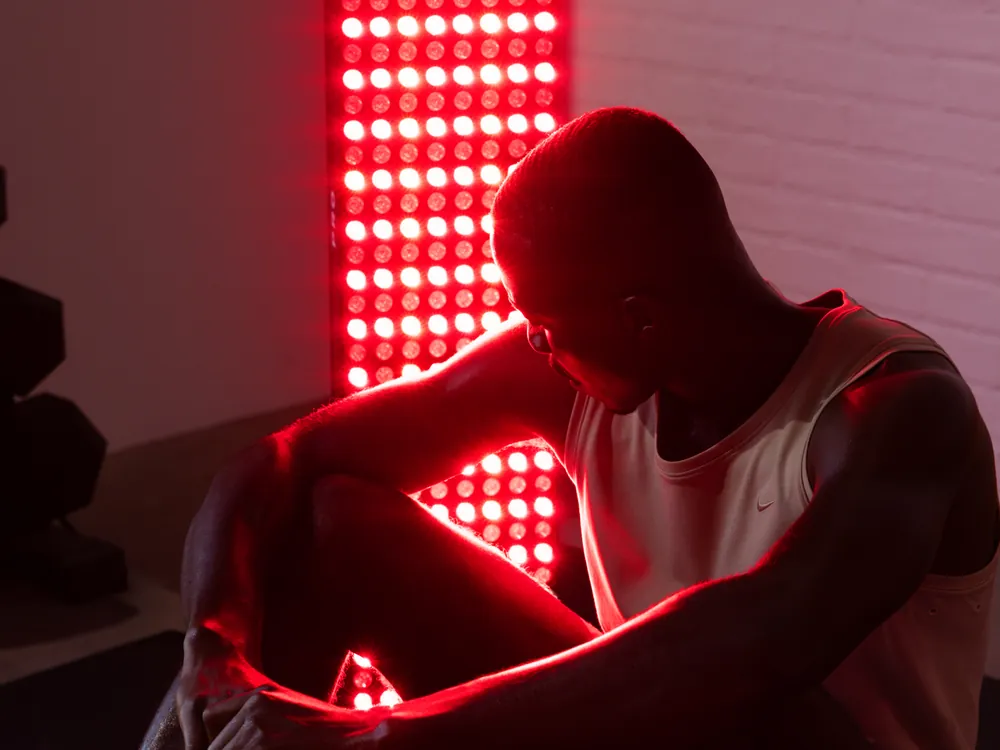
One reviewer on the BIOMAX PRO page arrived at the same conclusion from the other end, without a report:
★★★★★
“The irradiance is great, and I love that I don’t have to sit right up against it to get the full effect.”
Michael, June 2, 2026
The number you actually use is the one nobody prints
Intensity is a rate. What lands on your skin is a total, and the total is the thing the research is denominated in. It has a name, dose, a unit, joules per square centimeter, and a formula so simple it fits in a sentence.
Dose in one line
mW/cm² × seconds ÷ 1000 = J/cm²
Intensity times time. That is the whole thing. Which is why intensity without a clock, and a clock without a distance, tell you nothing.
Run it on the ULTRA, using the red band averages from the lab report, and the distances stop being an abstraction:
| Distance | Average irradiance | Dose in 10 min | Minutes to 20 J/cm² |
|---|---|---|---|
| 6 in | 56.22 mW/cm² | 33.7 J/cm² | 5.9 |
| 12 in | 47.78 | 28.7 | 7.0 |
| 18 in | 37.74 | 22.6 | 8.8 |
| 24 in | 30.18 | 18.1 | 11.0 |
The twenty joule column is an illustration, not a prescription. Pick any target you like and the shape holds: the same panel, the same session length, and the dose swings by nearly a factor of two depending on where you put the chair.
The reason to care is that more is not automatically better. The best known review of this problem, by Huang, Chen, Carroll and Hamblin in Dose-Response in 2009, is built around a curve that goes up and then comes back down:
if insufficient energy is applied there will be no response, if more energy is applied then a threshold is crossed and biostimulation is achieved. However when too much energy is applied then the stimulation disappears and is replaced by bioinhibition instead. Huang, Chen, Carroll, Hamblin, Biphasic Dose Response in Low Level Light Therapy, Dose-Response, 2009
Their examples are laboratory doses on cells and on mice, not a protocol for a person standing in a bedroom. In one mouse wound model a clear maximum appeared at 2 J/cm², while 50 J/cm² left the wound larger than in animals given no treatment at all. In fibroblasts, an 810 nm laser produced its greatest effect at 0.3 J/cm², less at 3, and less again at 30. You cannot map those numbers onto the surface dose a panel puts on skin and expect them to mean the same thing. What they do establish, and what nobody in this category disputes, is that the curve has a top.
Which reframes the entire shopping question. The strongest panel is not automatically the best panel. A panel with a high, evenly distributed, honestly documented output gives you control over the dose. A panel with an undocumented number gives you a guess, and the guess is the part that matters.
06 The limitsWhat a lab report does not tell you
Everything above is about light, and only about light. A photometry report measures photons leaving a panel. It says nothing about what happens after they reach you, and it is worth being blunt about that because the gap is where most of the marketing in this category lives.
PlatinumLED prints the boundary on the bottom of its own pages, and the wording comes straight from the regulatory category these devices sit in:
Our products are not intended to diagnose, treat, cure, or prevent any disease. Our products are low-risk, general wellness / fitness products in accordance with the “General Wellness: Policy on Low Risk Devices” draft released January 20, 2015. PlatinumLED site footer, referring to the FDA general wellness guidance
So the honest framing of a spec sheet is narrow and still useful. A good report tells you that a panel emits what it claims to emit, at a stated distance, across a stated band, with a stated evenness. That is a manufacturing and engineering claim, and it is checkable. Whether that light does anything for your shoulder is a different kind of question with a different kind of evidence, and no irradiance chart will settle it.
Anyone selling you certainty on the second question using data from the first is doing something you should notice.
07 The checklistFive things to ask for before you spend a thousand dollars
- The instrument.
Solar power meter or calibrated spectrometer. If the page does not say, ask. A brand that measured properly will tell you in one line, because it cost them money to do it.
- The distance.
An intensity figure with no distance is not a specification. Six inches flatters every panel ever built, and almost nobody uses one at six inches.
- The band.
350 to 1700 nm, or 600 to 700 nm, or something else. On the panel measured here the difference between those two is 46 mW/cm², which is more than the entire spread between many competing products.
- Point or average.
Center point or averaged across a defined target area, and if averaged, over what area. Ask for the max to min ratio while you are there. It is the one number that describes what your body actually sits in.
- The document.
A report number, a lab name, a test date, and a link. Everything above is unverifiable without it, and its absence is itself an answer.
If you take one thing
Ask for the second number. Every brand has a big one. The ones worth your money can also produce the small, awkward, averaged one, and the paperwork behind it.
Where PlatinumLED lands on its own five questions
This guide has used one company’s hardware throughout for a mundane reason. Its reports are public, per model, linked from the product page, and detailed enough to argue with. That is not a common state of affairs in this category, and it is what made the whole article possible.
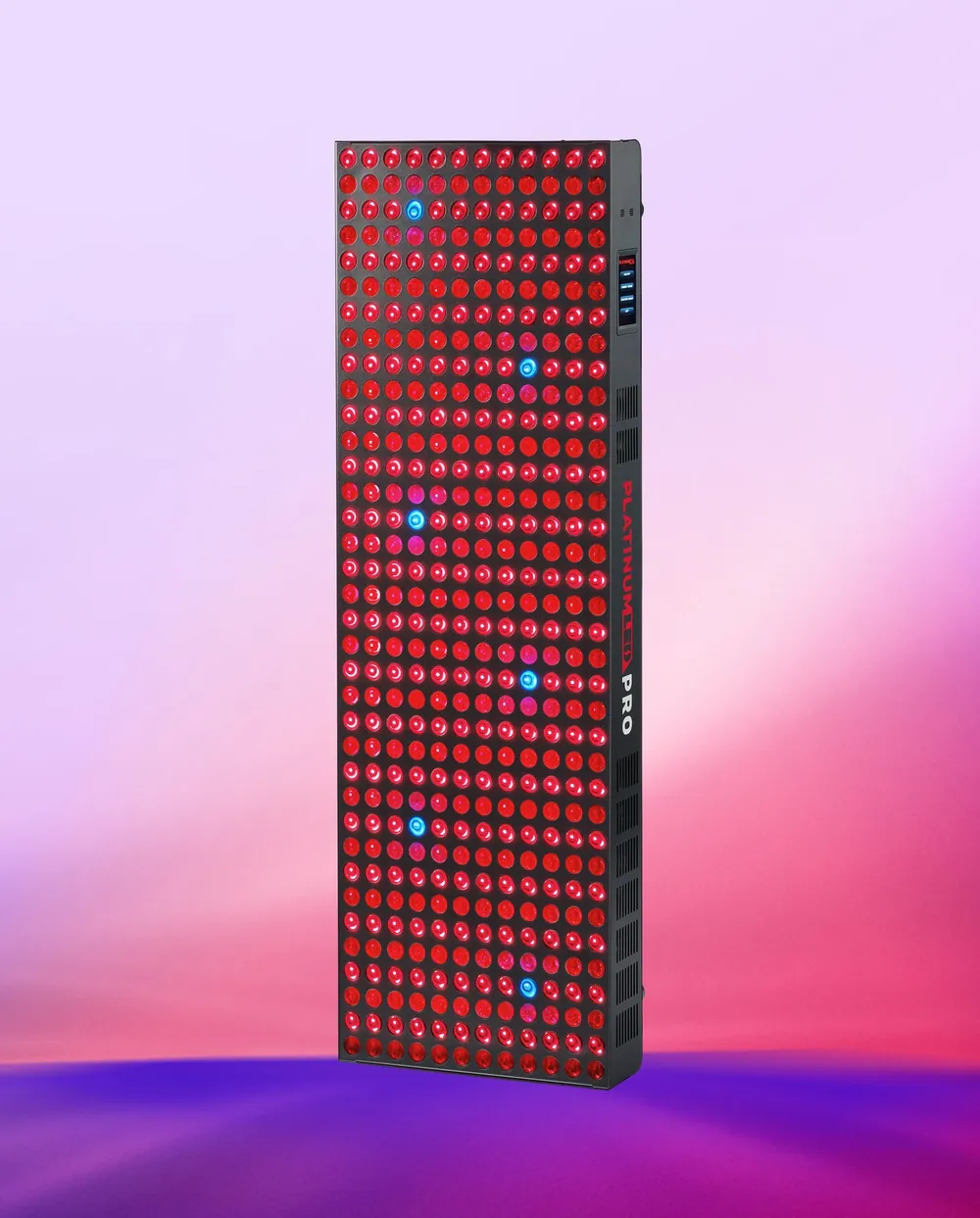
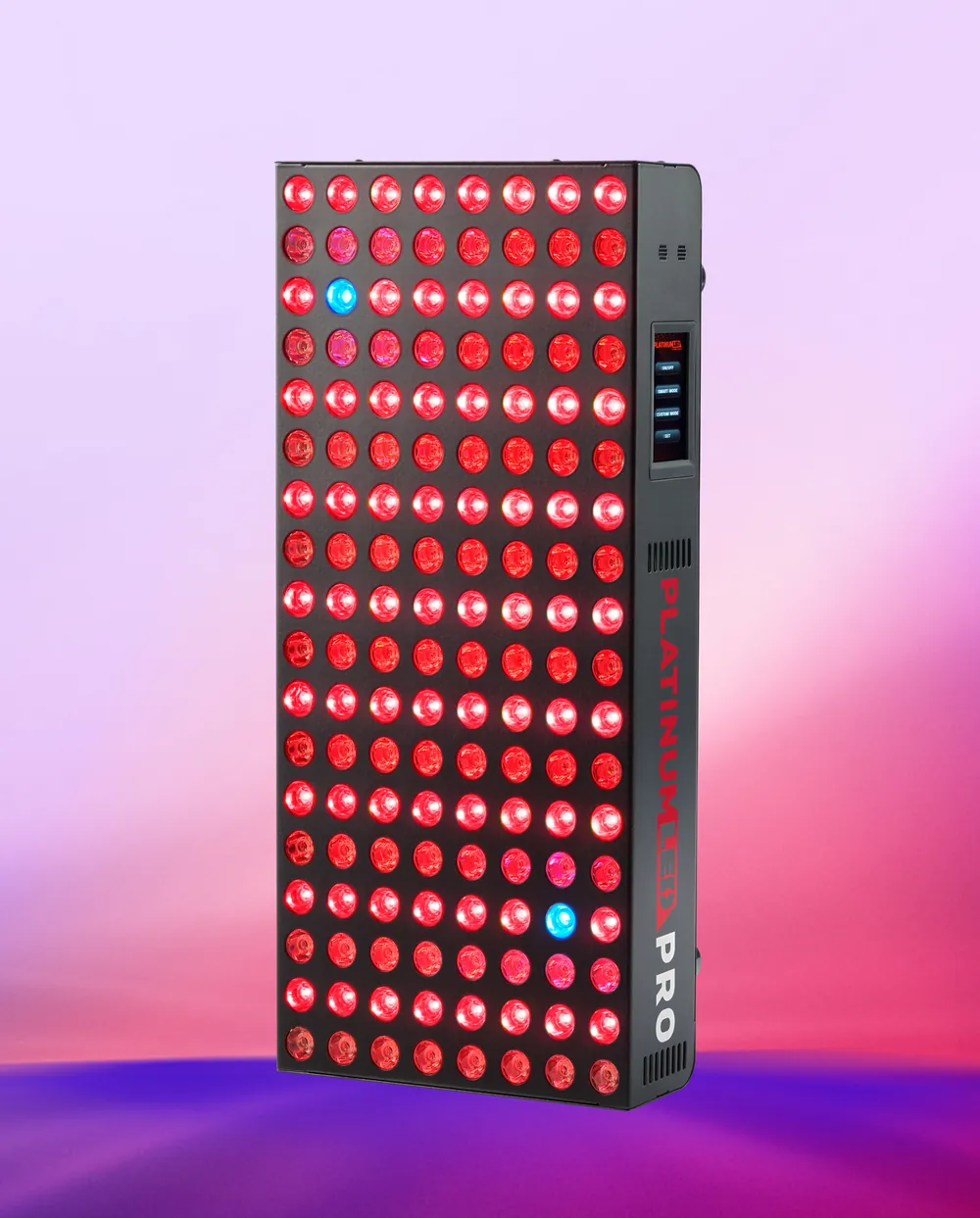
The company has been building these since 2010 and describes itself as the original red light therapy pioneer, which in a market this young is an unusually checkable claim. The four current PRO panels differ in size rather than in kind. Same seven wavelengths, same digital control, same third party testing, and a footprint grid of two heights by two widths:
| Model | Price | Notes |
|---|---|---|
| PRO NANO | $799 | 19 x 9 in, 144 emitters, 254.1 W measured |
| PRO MIDI | $999 | 19 x 12 in |
| PRO GRANDE | $1,299 | 36 x 9 in |
| PRO ULTRA | $1,599 | 36 x 12 in, 432 emitters, 772.6 W measured |
Two figures from the sphere test are worth putting next to each other, because they say something the intensity charts do not. In a two meter integrating sphere run to LM-79-19, the ULTRA drew 793.4 watts from the wall, and over twenty minutes of operation the sphere collected 321,439 joules of radiant energy. Divide the joules by the seconds and you get the second number below.
That ratio is what you are paying for when you pay for build quality in this category, and it appears on no product page anywhere, including theirs.
The paperwork, in one place
Alongside the LightLab intensity reports, PlatinumLED’s certifications page lists FDA Class II medical device registration for the BIOMAX and BIOMAX PRO lines, a Health Canada medical device license, ETL listing by Intertek against the IEC 60601 medical electrical equipment standards, CE, CB scheme and FCC Part 15 Subpart B. The BIOMAX and BIOMAX PRO panels carry a 60 day trial and a 3 year warranty. None of that tells you what the light does. All of it tells you the hardware was built by people who expected to be inspected.
★★★★★
“There are many choice in the market for RedLight panels. I based my decision of customer support, FDA approved product, user feedback and ease of use. Many of the panel look alike but they sure aren’t the same what they deliver.”
Matthew, November 16, 2025
★★★★★
“I also appreciate that Platinum Therapy Lights focuses on measurable specifications such as irradiance, wavelength selection, and coverage rather than marketing hype.”
Marat, June 11, 2026
The BIOMAX PRO page carries a 4.8 out of 5 rating, and the original BIOMAX series it grew out of sits at 4.9 across more than 2,900 reviews. Ratings are the softest evidence on this page and they belong at the end of it, underneath the report numbers, not on top of them.
Compare the four BIOMAX PRO panelsEvery model links its own third party test report
The short version
The category is loud and the numbers do not line up, but the fix is not more research. It is four questions and one document.
Ask which instrument. Ask at what distance. Ask across which wavelengths. Ask whether it is one point or an average, and over how big an area. Then ask to see the report. Any brand that can answer all five has probably built a panel worth buying, and any brand that cannot has told you everything you needed to know without meaning to.
The five answers, for the panel used throughout this page
Measured with what
Both. A solar power meter for the published chart, labeled as such, and Gigahertz-Optik spectral irradiance meters at an NVLAP accredited lab for the report.
At what distance
Six, twelve, eighteen and twenty four inches in the lab report. Six through thirty six on the published chart.
Across which wavelengths
Reported in three bands: 350 to 1700, 600 to 700, and 780 to 1700 nm.
One point or averaged
Both, plus the maximum, the minimum and the max to min ratio, over a stated six by six inch target area.
Where is the document
Linked from the product page, one report per model, with report number and test date.
That is a complete set of answers, which is the actual point of this page. Whatever you end up buying, ask the brand for the same five. The ones that can produce them are a shorter list than the category makes it look, and the shortness of that list is the decision.
See the BIOMAX PRO specificationsplatinumtherapylights.com